
INTRODUCTION
Job performance is one of the main factors determining organizational effectiveness, is a key element in ensuring the public health systems sustainability. (1)
While research has focused on the healthcare professionals’ performance, the healthcare entities’ performance is also determined by the effectiveness of administrative and financial sectors, which are responsible for planning, allocating, and overseeing the resources that enable the continuous provision of health services.(2,3) The following factors directly influence the quality of care provided to the population: effective financial management, equipment procurement, personnel recruitment, and proper implementation of the institutional budget. (3,4)
Today, public health systems face major challenges stemming from rising demand for care, an aging population, the need for health education, budgetary constraints, and the imperative to strengthen transparency in the use of public funds. (5,6) These circumstances increase the complexity of the tasks performed by finance teams, whose members must simultaneously contend with increasingly stringent administrative, regulatory, and technical requirements (4,7,8) Therefore, maintaining high levels of work performance is essential to guarantee the sustainability of health services and ensure institutional efficiency.
Work climate has received particular attention among several factors affecting work performance, given its potential to impact job satisfaction, organizational commitment, motivation, and productivity (9,10) Work climate is the sum of shared employee perceptions regarding institutional policies, leadership, communication, interpersonal relationships, opportunities for growth, and the circumstances under which work tasks are performed. (11) In contrast to organizational culture, which represents deeply rooted values, climate reflects day-to-day experiences that can be altered through human talent management strategies.
From an organizational psychology perspective, a positive work environment promotes collaboration among organizational members, strengthens trust in leaders, optimizes communication processes, and fosters a deeper identification with organizational goals. (11,12) Instead, environments characterized by poor coordination, limited recognition, interpersonal conflicts, or ineffective leadership tend to be associated with decreased motivation, increased work-related exhaustion, and reduced individual and group performance. (13)
Several studies conducted in healthcare institutions have demonstrated that a positive organizational environment encourage higher levels of job satisfaction, organizational commitment, psychological well-being, and staff retention. (14,15) Furthermore, organizations that promote participative leadership, effective communication, and organizational support experience lower turnover rates and higher productivity levels. (16) These findings indicate that organizational conditions affect not only employee well-being but also the overall quality of healthcare services and the effectiveness of administrative procedures. (15,17)
Job performance encompasses the extent to which an employee effectively performs assigned tasks and contributes to achieving institutional goals through behaviors associated with productivity, responsibility, work quality, compliance with regulations, initiative, and cooperation with other members of the organization. (18,19) For healthcare sector financial officers, these competencies are strategic because their decisions determine budget execution, expenditure control, procurement management, and compliance with administrative procedures established by current regulations. (20,21)
Financial officers in public healthcare institutions operate in contexts characterized by high levels of administrative responsibility, frequent audits, regulatory changes, and budgetary constraints. (22,23) When the organizational environment does not provide appropriate mechanisms for coordination, leadership, and support, these conditions may affect their performance. Instead, a positive organizational environment promotes communication between departments, strengthens institutional trust, and facilitates more effective administration, thereby enabling the operational needs of healthcare facilities to be met on time. (16,24)
The positive correlations between work climate and employee performance across various economic sectors is supported by the existing scientific evidence. (25,26) Recent studies indicate that factors such as leadership, teamwork, communication within the organization, involvement in decision-making, and professional recognition contribute significantly to variability in job performance. (27) Nevertheless, most of these studies have been conducted among clinical professionals, particularly physicians and nurses, due to their direct impact on quality of care. In contrast, despite performing functions that are essential to the sustainability of healthcare institutions, financial and administrative employees in the healthcare sector remain an understudied population.
In Latin American public health systems, where institutions often operate under financial constraints, high demand for services, and complex administrative processes, the need to further investigate this issue is particularly important. (28) Improving work climate represents a management option in these contexts that may enhance staff performance without requiring substantial structural investments. Nevertheless, there is still limited empirical evidence examining this particular relationship among financial officers in public healthcare institutions in Ecuador, representing a significant knowledge gap in the organizational management of the national context.
From a practical approach, identifying work climate as an indicator of job performance will facilitate the generation of valuable evidence to guide human talent management policies focused on improving institutional communication, promoting teamwork, strengthening leadership, and increasing organizational commitment. (29) These actions have the potential to promote healthier work environments, improve administrative efficiency, and foster more effective use of public resources allocated to the healthcare sector.
This research’s findings will contribute to a better understanding of the organizational factors that determine administrative performance, provide evidence from an understudied professional group, and offer a scientific basis for developing strategies aimed at optimizing financial management and the continuous improvement of healthcare institutions. Therefore, this research objective is to analyze the work climate predictive capacity on the financial officers’ job performance in public healthcare institutions.
METHODS
A quantitative, applied approach, with a non-experimental, cross-sectional design was adopted. Its scope was correlational-predictive, as it analyzed the relationship between organizational climate and job performance, as well as the predictive capacity of the former regarding the latter through inferential statistical analyses.
A sample of 200 participants was studied (N=415; Confidence: 95%; Error: 5%). The estimation of the sample size was based on the criteria proposed by Cohen, considering a statistical significance level of α = 0.05, a statistical power of 80% (1-β = 0.80), and an expected medium effect size (f² = 0.15). In characterizing the study population, the following inclusion criteria were considered:
- To be an active officer in the financial or administrative-accounting area of a public healthcare institution, including professionals involved in budget, accounting, treasury, financial planning, public procurement, or institutional economic management. 2) To have a minimum length of employment of six months in the institution, in order to ensure that participants had sufficient experience to assess the characteristics of the w climate and internal working conditions. 3) To maintain a current employment relationship during the data collection period, regardless of the contractual arrangement established by the institution. 4) To be aged 18 years or older, complying with the ethical criteria established for voluntary participation in research involving human beings. 5) To voluntarily agree to participate in the study by signing the informed consent form, thereby ensuring the autonomy, confidentiality, and protection of the data collected.
The research was conducted using a quantitative, non-experimental, cross-sectional design with a correlational-predictive scope, aimed at analyzing the capacity of work climate to predict the job performance of financial officers working in public healthcare institutions.
In the first phase, authorization was obtained from the participating institutions to conduct the study, and the information collection process was coordinated with those responsible for the administrative and financial areas. Afterwards, potential participants were informed about the objectives of the research, the strictly academic nature of the study, the voluntary nature of their participation, and the guarantees of confidentiality and anonymity of the information collected. Only those officers who agreed to participate by signing the informed consent form were included in the study, in accordance with the ethical principles applicable to research involving human beings.
Once data collection had been completed, the data were coded, refined, and verified before being entered into the database for statistical analysis. Initially, a descriptive analysis of the variables was performed using measures of central tendency and dispersion. Subsequently, considering the nature of the data, Spearman's correlation coefficient was used to determine the relationship between work climate and job performance, as well as between their respective dimensions. To assess the predictive capacity of work climate on job performance, linear regression models were applied, estimating standardized coefficients, 95% confidence intervals, the coefficient of determination (R²), and the corresponding levels of statistical significance.
Additionally, a multivariate analysis was conducted to identify the dimensions of work climate that made the greatest contribution to job performance, thereby establishing the relative predictive weight of each dimension. Finally, the psychometric properties of the Work Climate Measure were evaluated through exploratory factor analysis, verifying sampling adequacy using the Kaiser-Meyer-Olkin (KMO) index, Bartlett's test of sphericity, factor loadings, total explained variance, and the internal consistency of each dimension using Cronbach's alpha coefficient. A statistical significance level of p < 0.05 was established for all inferential analyses.
To fulfil the objective of the research, the following assessment instruments were applied:
- Work climate Measure (WCM): assesses employees' shared perceptions of the practices, procedures, and internal conditions of the organization. (30) Methodology: Self-administered organizational perception questionnaire (Administration: 15–20 minutes), comprising 58 items and 17 organizational dimensions or scales. Dimensions: Organizational integration; Participation; Supervisor support; Organizational clarity; Communication; Innovation and flexibility; Work pressure; Reward and recognition. Norms: 5-point Likert-type scale (1 = Strongly disagree to 5 = Strongly agree), with specific norms for the Organizational Climate Level (≤ 33rd percentile/Low; 34th–66th percentile/Moderate; ≥ 67th percentile/High).
- Individual Work Performance Questionnaire (IWPQ): assesses individual performance in different work contexts. (31) Methodology: Self-administered questionnaire assessing perceived performance, comprising 18 items (Administration: 5–10 minutes). Dimensions: Task performance; Contextual performance; Counterproductive work behaviors. Norms: 5-point Likert-type scale (1 = Never to 5 = Always), with the recommended percentile conversion norms (≤ P33/Low; P34–P66/Moderate; ≥ P67/High).
The data were processed using descriptive and inferential statistics after determining that the data did not follow a normal distribution according to the Kolmogorov-Smirnov test. Measures of central tendency and dispersion were calculated to characterize the study variables. The relationship between organizational climate and job performance, as well as between their dimensions, was assessed using Spearman's correlation coefficient. Afterwards, linear regression models were applied to determine the predictive capacity of organizational work on job performance and to identify the dimensions with the greatest contribution to the model. Finally, an exploratory factor analysis was conducted to evaluate the structure of the instrument, verifying sampling adequacy using the Kaiser-Meyer-Olkin (KMO) index, Bartlett's test of sphericity, and internal consistency using Cronbach's alpha coefficient. A statistical significance level of p < 0.05 was considered in all analyses, and they were performed using SPSS v27.
RESULTS
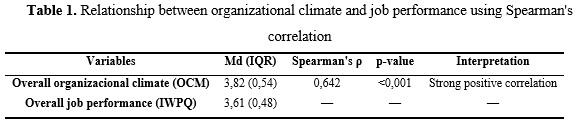
A positive and statistically significant correlation was observed between work climate and job performance (ρ = 0.642; p < 0.001), indicating that officers who perceive better organizational conditions exhibit higher levels of job performance. The magnitude of the coefficient indicates a strong association, whereby an improvement in the institutional climate is associated with a favorable increase in individual performance. (Table 1).
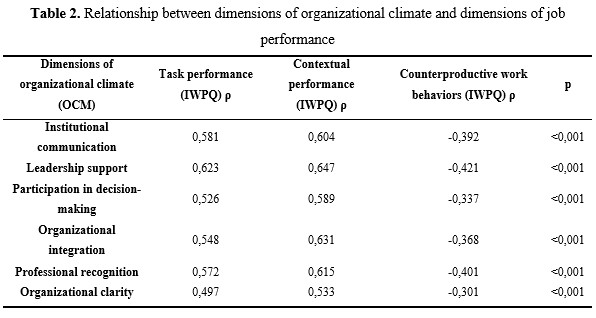
All dimensions of work climate showed statistically significant associations with the dimensions of job performance (p < 0.001). Leadership support showed the strongest association with contextual performance (ρ = 0.647), followed by organizational integration (ρ = 0.631).
Likewise, statistically significant negative associations were observed between all the evaluated dimensions of organizational climate and counterproductive work behaviors. The coefficients ranged from ρ = −0.301 for organizational clarity to ρ = −0.421 for leadership support. In particular, leadership support showed the strongest negative association with counterproductive work behaviors (ρ = −0.421), followed by professional recognition (ρ = −0.401) and institutional communication (ρ = −0.392). These results indicate that a more favorable perception of organizational climate conditions was associated with a lower frequency of counterproductive work behaviors among the officers evaluated. (Table 2).
The predictive model showed that organizational climate explains approximately 46.8 % of the variability in job performance (R² = 0.468). The standardized coefficient (β = 0.684; p < 0.001) confirms that organizational climate constitutes a significant predictor of the performance of financial officers (Table 3 and Table 4).


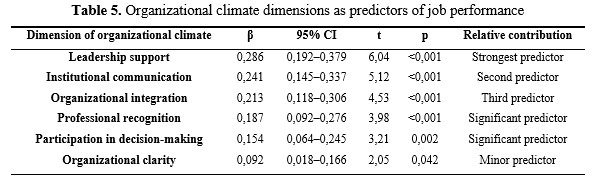
The multivariate analysis identified six dimensions of organizational climate that significantly predict job performance. Leadership support showed the greatest predictive weight (β = 0.286; p < 0.001), followed by institutional communication (β = 0.241; p < 0.001) and organizational integration (β = 0.213; p < 0.001). These results indicate that strategies focused on leadership and communication could generate greater effects on job performance (Table 5).
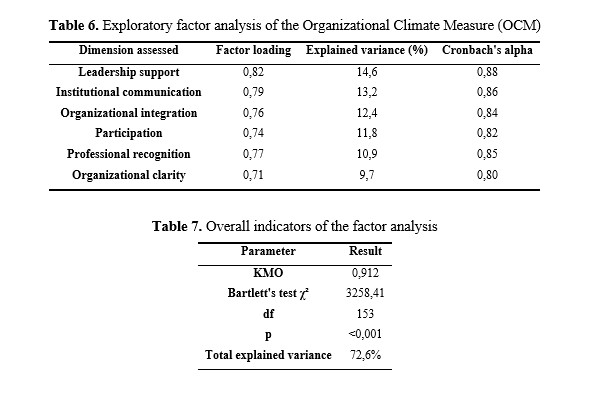
The factor analysis showed an adequate structure of the instrument, with an excellent KMO index (0.912) and a significant Bartlett's test (p < 0.001), confirming the feasibility of factor analysis. The identified dimensions explained 72.6% of the total variance, with factor loadings above 0.70 and adequate reliability coefficients (α = 0.80–0.88) (Table 6 and Table 7).
DISCUSSION
The obtained results confirm the achievement of the research objective, which was aimed at analyzing the predictive capacity of organizational climate on the financial officers’ job performance in public healthcare institutions. Likewise, the empirical evidence supports the acceptance of the proposed hypothesis, demonstrating that a positive organizational climate constitutes a significant predictor of job performance. The high positive correlation observed between both variables (ρ = 0.642; p < 0.001), together with the explanatory capacity of the regression model (R² = 0.468), demonstrates that almost half of the variability in job performance can be attributed to the organizational conditions perceived by employees. These findings support the theoretical premise that organizational factors not only influence employees’ psychological well-being but also represent relevant determinants of productivity and institutional effectiveness, particularly in public organizations characterized by high levels of administrative demands.
The identified association is particularly relevant considering the specific context in which the research was conducted. Financial officers in public healthcare institutions perform activities subject to strict regulatory controls, continuous audits, budgetary constraints, and high levels of administrative responsibility. In this context, having an organizational environment characterized by effective leadership, fluid communication, clarity of processes, and adequate institutional integration facilitates coordination among administrative units, reduces job-related uncertainty, and strengthens the capacity to respond to the requirements inherent to the healthcare system. Consequently, the findings support the assertion that organizational climate constitutes a strategic resource capable of increasing administrative efficiency without necessarily requiring high-cost structural modifications.
Particularly relevant is the finding that leadership support constitutes the dimension with the greatest predictive capacity for job performance (β = 0.286), followed by institutional communication (β = 0.241) and organizational integration (β = 0.213). These findings suggest that leadership processes exert a transversal effect on the functioning of public healthcare organizations by promoting activity coordination, conflict resolution, institutional trust, and employee motivation. From an organizational psychology perspective, effective leadership acts as a facilitator of job resources, enabling employees to interpret institutional priorities more clearly and direct their efforts towards the achievement of organizational objectives.
The findings match with the conceptual model proposed by Schneider et al. (11), who argue that organizational climate represents the shared perception of institutional practices, policies, and procedures, thereby directly conditioning employees’ work behaviors. Similarly, the results are consistent with the systematic review conducted by Murillo Núñez (25), who concluded that organizational climate constitutes one of the most consistent determinants of job performance across different productive sectors. However, the present study extends this body of knowledge by demonstrating that this relationship is also maintained among financial officers working in the public healthcare sector, a population that has received considerably less attention in the international literature.
The obtained results are also related to the research conducted by Kluger et al. (27), who identified that the communication quality and the perception of being heard by leaders significantly increase multiple indicators of job performance. In the present study, institutional communication emerged as the second most important predictor of performance, suggesting that communication mechanisms facilitate information exchange, reduce administrative errors, and strengthen coordination among financial departments. In public healthcare institutions, where budgetary management depends on continuous interaction among multiple administrative units, effective communication may directly translate into more efficient financial processes and more rational use of public resources.
Likewise, the leadership main role is consistent with the evidence synthesized by Specchia et al. (16), who demonstrated that participatory leadership styles improve job satisfaction, organizational commitment, and the performance of healthcare workers. Although that study focused primarily on nursing personnel, the findings of the present research make it possible to extend these conclusions to the financial-administrative context, indicating that the positive influence of leadership transcends clinical functions and constitutes a common organizational factor across different professional profiles within healthcare institutions.
The results also show agreement with the Noorfallah et al propositions, (29), who identified organizational climate, institutional commitment, and leadership as variables that interact to explain job performance. In the present study, although only the direct effect of organizational climate was analyzed, the high predictive capacity identified (R² = 0.468) suggests that the institutional environment represents a central component within the set of factors determining the performance of financial officers. Nevertheless, the proportion of unexplained variance indicates that other individual and organizational variables, such as job satisfaction, organizational commitment, emotional intelligence, workload, or occupational stress, could complement the predictive model and be incorporated into future research.
This interpretation is consistent with the systematic reviews conducted by Boskma et al. (15) and Rafi’i et al. (14) who concluded that interventions aimed at improving the organizational environment produce positive effects on healthcare personnel’s well-being, job satisfaction, and retention within institutions. Although these studies primarily analyzed variables related to occupational well-being, the findings of the present study extend this evidence by demonstrating that a favorable organizational climate also directly affects the job performance of financial personnel, who are responsible for budget planning, financial resource management, and compliance with financial regulations.
Another relevant aspect concerns the negative relationship identified between the dimensions of organizational climate and counterproductive behaviors. This result has important implications for public administration, as it demonstrates that better organizational conditions not only promote higher levels of productivity but also reduce behaviors that affect institutional efficiency, such as interpersonal conflicts, non-compliance with procedures, decreased organizational commitment, or demotivated attitudes. Consequently, improving the organizational climate can be interpreted as a preventive strategy aimed at reducing organizational risk factors that affect the day-to-day functioning of public healthcare institutions.
An additional contribution of the study lies in the hierarchical identification of the organizational dimensions with the greatest predictive capacity. While numerous studies are limited to establish global associations between organizational climate and job performance, the present study identifies which specific components make the greatest contribution to performance. The evidence demonstrates that leadership, institutional communication, and organizational integration account for the greatest influence on performance, providing useful information for prioritizing organizational interventions. This approach makes it possible to guide human talent management policies more efficiently, optimizing the allocation of resources aimed at institutional strengthening.
Nevertheless, the obtained results in the present study should be interpreted considering several limitations. The cross-sectional design prevents definitive causal relationships from being established between organizational climate and job performance; therefore, it is only possible to assert the existence of associations and predictive capacity within the specific period in which the variables were assessed. Likewise, the use of self-report questionnaires may introduce biases associated with social desirability or participants’ subjective perceptions. Similarly, the research was conducted exclusively among financial officers belonging to public healthcare institutions, which limits the generalizability of the findings to private organizations, other sectors of public administration, or different cultural contexts. Finally, although the predictive model explains a considerable proportion of the variability in job performance, an important percentage remains associated with individual, organizational, and contextual factors that were not included in the present study.
Taking into account these limitations, future research should develop longitudinal designs to examine the temporal stability of the relationships identified and establish more precisely the causal direction between the variables. Likewise, it would be appropriate to incorporate structural equation models to simultaneously analyze direct and indirect relationships among organizational climate, leadership, job satisfaction, organizational commitment, psychological well-being, and job performance. Similarly, multicenter studies conducted across different regions or countries would make it possible to assess the cross-cultural stability of the model identified and expand the generalizability of the findings. Finally, it is recommended that intervention studies aimed at strengthening organizational leadership, institutional communication, and employee participation be implemented, with the purpose of experimentally evaluating the impact of these strategies on job performance and administrative efficiency in public healthcare institutions.
The findings obtained consolidate the evidence that organizational climate constitutes a strategic determinant of job performance among financial officers in the healthcare sector. Beyond confirming associations previously described in other organizational settings, the study demonstrates that institutional conditions represent a fundamental mechanism for optimizing administrative management and strengthening the sustainability of public healthcare systems. Consequently, the promotion of organizational environments characterized by effective leadership, open communication, institutional integration, professional recognition, and active employee participation should be considered a priority for human talent management policies, as it constitutes a strategy capable of simultaneously improving job performance, administrative efficiency, and the quality of services received by citizens.
Conflict of Interest
The authors declare that there are no conflicts of interest.
Author Contributions
Conceptualization: Daniel Esteban Velasco-Reyes.
Research: Daniel Esteban Velasco-Reyes; Ximena Elizabeth Flores-López.
Data collect: Ximena Elizabeth Flores-López; Ericka Gabriela Martínez-Pastor.
Formal analysis: Ximena Elizabeth Flores-López; Ericka Gabriela Martínez-Pastor; Daniel Alberto Salazar-Burbano.
Methodology: Daniel Esteban Velasco-Reyes.
Validation: Daniel Alberto Salazar-Burbano.
Project management: Daniel Esteban Velasco-Reyes.
Drafting the original version: Daniel Esteban Velasco-Reyes.
Writing, reviewing, and editing: Daniel Esteban Velasco-Reyes.
Financing
No external financing.
REFERENCES
1.World Health Organization. Assessing Health System Performance: Proof of Concept for a HSPA Dashboard of Key Indicators. Ginebra: OECD Publishing & World Health Organization; 2023.
2.Newton-Lewis T, Munar W, Chanturidze T. Performance management in complex adaptive systems: a conceptual framework for health systems. BMJ Global Health. 2021;6(7): e005582.
3.Evans J, Leggat SG, Samson D. A systematic review of the evidence of how hospitals capture financial benefits of process improvement and the impact on hospital financial performance. BMC Health Services Research. 2023;23(1):237-42.
4.Hanson K, Brikci N, Erlangga D, Alebachew A, De Allegri M, Balabanova D, et al. The Lancet Global Health Commission on financing primary health care: putting people at the centre. The Lancet Global Health. 2022;10(5):e715-e772.
5.Rojo-Ramos J, Calero-Morales S, Gómez-Paniagua S, Galán-Arroyo C. Cyberbullying and self-concept in physical education school children. Espiral. Cuadernos del Profesorado. 2024;17(35): 1-15.
6.Kickbusch I, Piselli D, Agrawal A, Balicer R, Banner O, Adelhardt M, et al. The Lancet and Financial Times Commission on governing health futures 2030: growing up in a digital world. The Lancet. 2021;398(10312):1727-76.
7.Wishnia J, Goudge J. Strengthening public financial management in the health sector: a qualitative case study from South Africa. BMJ Global Health. 2021;6(11):e006911.
8.Vinueza-Tapia EO, Millán-Caballero R, Sánchez-Córdova B, Calero-Morales S. Quality of management in physical activity, sports and health in the provincia de Orellana, Ecuador. Revista Médica Electrónica[Internet]. 2025[citado 24/05/2026];47:e6592. Disponible en: http://scielo.sld.cu/pdf/rme/v47/1684-1824-rme-47-e6592.pdf
9.Bulińska-Stangrecka H, Bagieńska A. The role of employee relations in shaping job satisfaction as an element promoting positive mental health at work in the era of COVID-19. Int J Environ Res Public Health. 2021;18(4):1903.
10.Xu X, Zhao P, Hayes R, Le N, Dormann C. Revisit the causal inference between organizational commitment and job satisfaction: A meta-analysis disentangling its sources of inconsistencies. J Applied Psychol. 2023;108(7):1244-61.
11.Schneider B, Ehrhart MG, Macey WH. Organizational climate and culture: History, current status, integration, and change. Annu Rev Organ Psychol Organ Behav. 2026;13(1):309-35.
12.Karikumpu V, Häggman-Laitila A, Romppanen J, Kangasniemi M, Terkamo-Moisio A. Trust in the leader and trust in the organization in healthcare: A concept analysis based on a systematic review. J Nurs Management. 2024; 2024(1): p. 8776286.
13.Zara J, Nordin SM, Isha AS. Influence of communication determinants on safety commitment in a high-risk workplace: a systematic literature review of four communication dimensions. Front Public Health. 2023:11:1225995.
14.Rafi’i MR, Hanif SA, Bin Daud F. Exploring the link between healthcare organizational culture and provider work satisfaction: a systematic review. BMC Health Serv Res. 2025;25(1):904.
15.Boskma A, van der Braak K, Hooft L, Oerbekke M, Franx A, van der Laan M. Effectiveness of organization-directed interventions on healthcare professionals' well-being: a systematic review. EClinicalMedicine. 2025;88:103496.
16.Specchia ML, Cozzolino MR, Carini E, Di Pilla A, Galletti C, Ricciardi W, et al. Leadership styles and nurses’ job satisfaction. Results of a systematic review. IJERPH. 2021;18(4):1552.
17.Klimanskaitė A, Andruškienė J, Grubliauskienė J, Truš M. Psychosocial hospital work environment and nurses' health assessed with salutogenic indicators: a systematic review. Front Public Health. 2026;14:1738847.
18.Aguinis H. Performance Management. 5th ed. Chicago Business Press; 2023.
19.Cascio WF, Aguinis H. Applied Psychology in Talent Management. 9th ed. Los Ángeles: Sage Publications; 2024.
20.Bandy G. Financial management and accounting in the public sector. Londres: Routledge; 2023.
21.Sagarra-Romero L, Monroy Antón A, Calero Morales S, Ruidiaz Peña M. ithlete Heart Rate Variability app: knowing when to train. British J Sports Medic. 2017;51:1-3.
22.Musiega A, Tsofa B, Barasa E. How does Public Financial Management (PFM) influence health system efficiency: A scoping review. Wellcome Open Research. 2024;9:566.
23.Tapsoba Y, Silim A, Frimpong KA, Barroy H. Does public financial management save life? Evidence from a quantitative review of PFM and health outcomes in sub-Saharan African countries. Health Systems & Reform. 2024;10(1):2298190.
24.Minahan GE, Thompson SC. Organizational Climate Factors Influencing Job Satisfaction in Rural Health Care Workplaces in Upper-Middle-Income and High-Income Countries: A Scoping Review. Healthcare. 2026;14(9):1238.
25.Murillo Núñez LE. Efecto del clima organizacional institucional en el desempeño laboral: Una revisión. Investigación y Desarrollo. 2026;34(1):338-71.
26.Muñoz Medina F, López Bohle SA, Beurden J, Chambel MJ, Ugarte SM. The relationship between job insecurity and employee performance: a systematic literature review and research agenda. Career Development International. 2023;28(6-7):589-632.
27.Kluger AN, Lehmann M, Aguinis H, Itzchakov G, Gordoni G, Zyberaj J, et al. A meta-analytic systematic review and theory of the effects of perceived listening on work outcomes. Journal of Business and Psychology. 2024;39(2): 295-344.
28.Barrios OA, Pérez-Cuevas R. Strengthening healthcare systems in Latin America. Post-pandemic efforts. Arch Med Res. 2024;55(7):103070.
29.Noorfallah H, Mutmainah I, Rumna R. Influence of organizational climate, engagement, and commitment on performance with leadership as moderation variables. Brilliant International Journal Of Management And Tourism. 2022;2(2):81-5.
30.Patterson MG, West MA, Shackleton VJ, Dawson JF, Lawthom R, Maitlis S, et al. Validating the organizational climate measure: links to managerial practices, productivity and innovation. Journal Organizational Behavior. 2005;26(4):379-408.
31.Koopmans L, Bernaards CM, Hildebrandt VH, Van Buuren S, Van der Beek AJ, De Vet H. Improving the individual work performance questionnaire using rasch analysis. Journal Applied Measurement. 2014;15(2):60-175.